
The Mistake Most Homeowners Make First
The first instinct, when someone finally decides to give their garage door some attention, is to grab a can of WD-40 and spray every moving part they can reach. It feels productive. It's fast, it's cheap, and the door usually does run quieter for a week or two. The problem is that WD-40 is a solvent, not a lubricant. It strips old grease away, then evaporates, leaving metal-on-metal contact that wears faster than before. Worse, in a dry season like the one Santa Barbara just came through, that thin residue grabs dust and road grit like flypaper, which is exactly how rollers and hinges end up gritty and stiff by the time winter rain arrives. The fix isn't more effort, it's using the right product in the right spots, which is most of what this routine is about.
What You'll Need
Gather these before you start so you're not climbing up and down the ladder:
- A sturdy step ladder
- A flashlight (garage lighting rarely reaches the top of the track)
- A socket wrench or nut driver set
- Silicone-based garage door lubricant, not WD-40 or a general household oil
- A clean rag and a soft brush or vacuum with a hose attachment
- A tape measure (optional, for the balance test)
The 20-Minute Routine, Step by Step
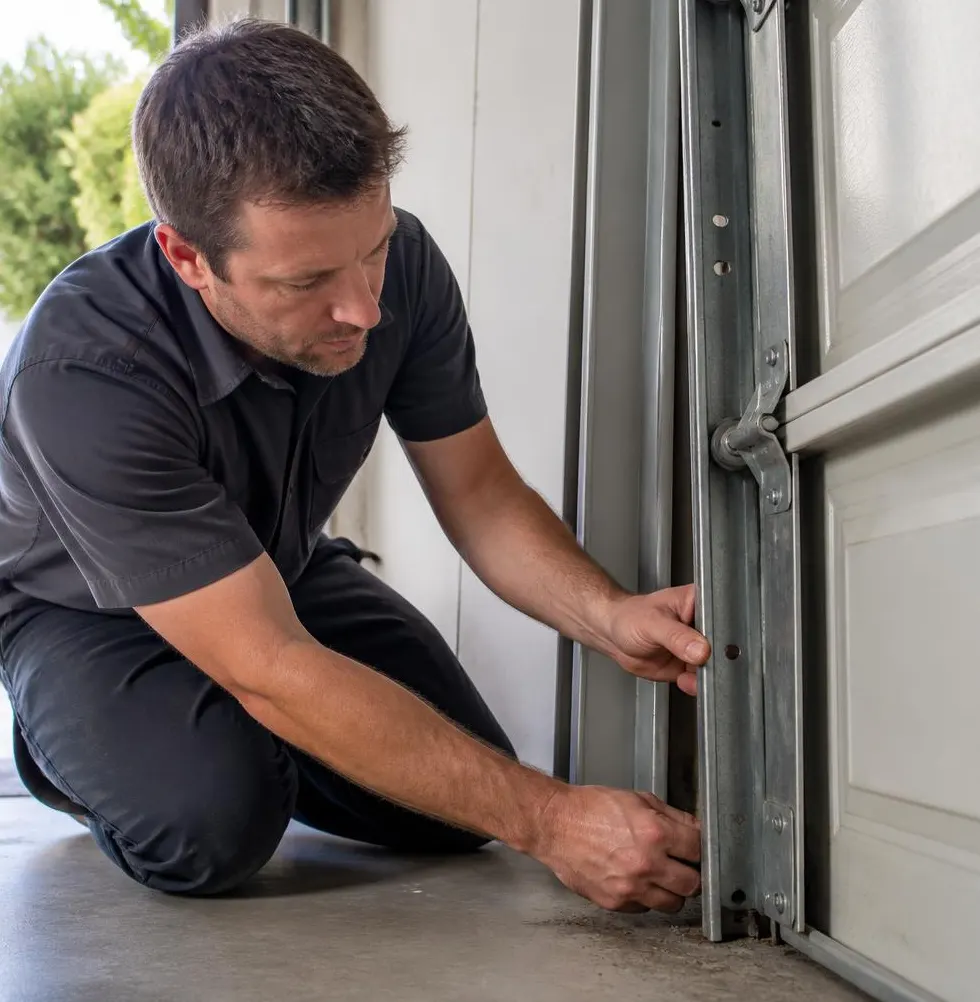
- Look before you touch (2 minutes). Walk the full length of both tracks with the flashlight. Check for dents, gaps where the track has pulled from the wall, and any buildup of dust or salt film, especially if your garage faces the ocean or sits in a coastal neighborhood like Montecito or Summerland. Look at the panels themselves for new rust spots or cracking along the bottom seal.
- Clear the tracks. Use the brush or vacuum to pull out dried leaves, spiderwebs, and the fine dust that builds up every summer. A dry rag works for wiping down any salt residue on the hardware, which otherwise sets in and accelerates corrosion over the wet months ahead.
- Check and tighten hardware. Roller brackets, hinges, and the bolts holding the track to the wall all loosen slightly over time, partly from daily vibration and partly from the small seismic shifts a lot of Santa Barbara area homes experience. Run a wrench over every visible bolt. Snug, not over-tightened.
- Lubricate the moving parts, correctly. Apply a light coat of silicone-based lubricant to the rollers, hinges, and the track's rolling surface only. Skip the springs entirely; lubricating springs is a job that comes with real risk and is best left alone by a homeowner.
- Test the auto-reverse safety feature. Place a block of wood or a roll of paper towels flat on the ground where the door closes. Run the door down. It should reverse the instant it touches the object. If it doesn't, stop using the opener until it's inspected.
- Do a balance test. Disconnect the opener by pulling the release cord, then lift the door manually about halfway. A properly balanced door stays put on its own. If it drifts up or crashes down, the spring tension is off, which is a job for a technician, not a DIY fix.
- Inspect the weatherstripping and bottom seal. With winter rain on the way, cracked or flattened seals let water and wind-driven dust into the garage. If it's brittle or torn, note it for replacement before the storms pick up.
- Listen to a full cycle. With everything reconnected, run the door up and down one more time and just listen. Grinding, popping, or a rhythmic thud usually points to something specific, a worn roller, a loose hinge, or a spring under strain, and it's much easier to catch now than after it fails.
What's Safe for Homeowners vs. What Needs a Technician
This routine is designed to stay inside the boundaries of what's reasonably safe to do yourself:
- Homeowner territory: visual inspection, cleaning tracks, lubricating rollers and hinges, tightening visible hardware with hand tools, the auto-reverse test, and listening for new sounds.
- Technician territory: anything involving the springs (adjustment, tension, or replacement), frayed or snapped cables, a door that's visibly off-track, bent tracks that need to be reset, or opener issues that go beyond the remote and sensors. These involve components under heavy tension or electrical work, and the margin for a serious injury is real.
If the balance test, the auto-reverse test, or the listening check turns up anything unusual, that's the signal to stop and call it in rather than push through with more lubricant or a bigger wrench.
When to Call Santa Barbara Garage Door Service
If your seasonal check turns up a door that won't hold its position, hardware that's rusted past a simple wipe-down, or an opener that hesitates before reversing, it's time to bring in a technician. Our Garage Door Maintenance visits cover a full tune-up, including spring tension checks, track alignment, and hardware replacement where salt air or age has taken a toll. If the issue is on the opener side, our Garage Door Opener Repair & Installation service handles everything from faulty safety sensors to units that are simply past their reliable years. We work throughout Santa Barbara, Goleta, Montecito, Carpinteria, Summerland, Isla Vista, Hope Ranch, and Ventura, and we show up on time and explain exactly what we find.
Get your garage door ready for the rainy season. Call Santa Barbara Garage Door Service today for a maintenance visit in Santa Barbara, CA.